I Wasn't Trying to Become a Bodybuilder. I Just Wanted My Energy, Drive, and Momentum Back.
What happened when a 44-year-old disciplined lifter stopped obsessing over the bathroom scale, discovered the deep abdominal fat living behind the muscle wall, and investigated targeted GHRH clinical research.
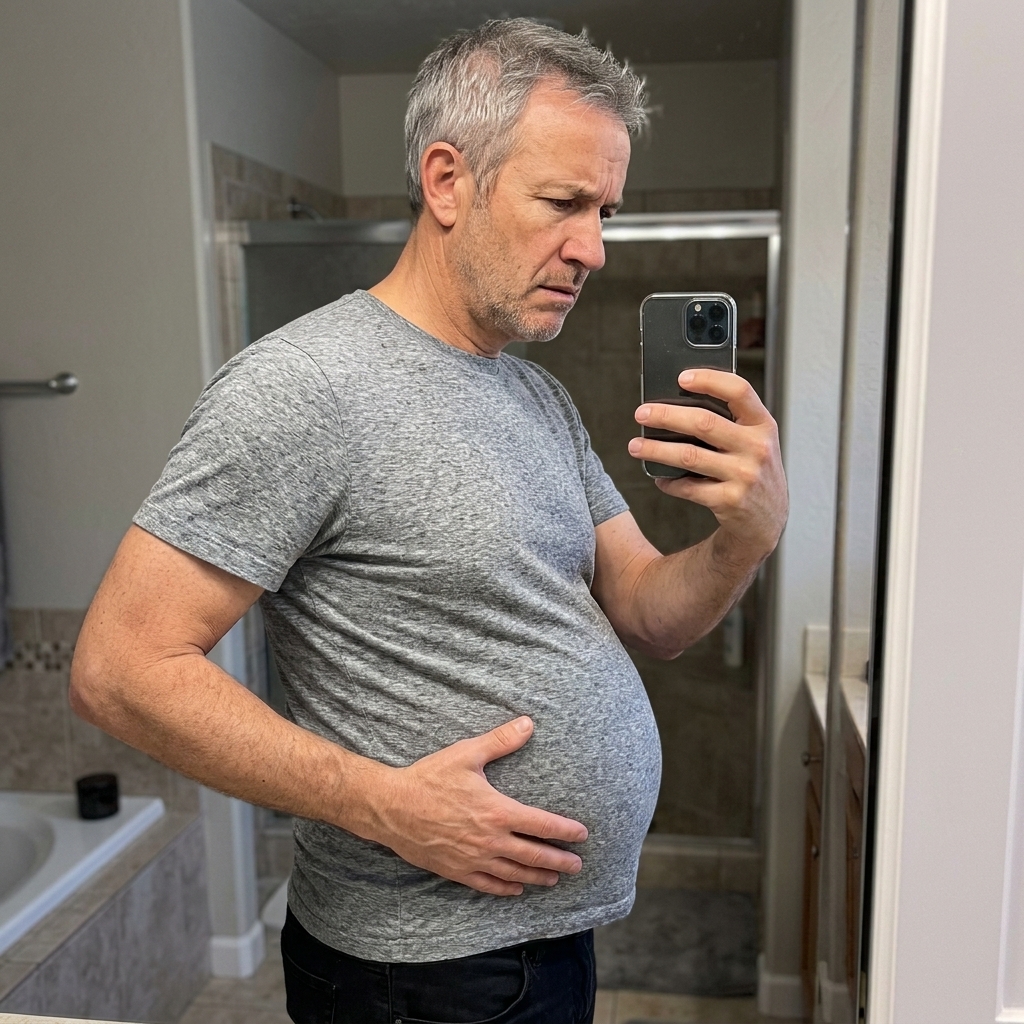
Photo illustration · Patient educational series.
1. The Frustration of Doing Everything Right
I wasn’t trying to become a professional bodybuilder or step on a fitness stage. I didn’t need veins across my abs or a single-digit body fat percentage. I just wanted to look in the mirror in the morning and see a guy who still had the stamina to train hard, work with sharp focus, and actually enjoy his life.
But that stubborn belly fat just wouldn’t go away.
I used to think getting rid of midsection fat after 40 was simply a matter of eating less and spending even more hours in the gym. So I did what disciplined men do:
- I cleaned up my diet and tracked my macros religiously.
- I trained with weights consistently 4 days a week.
- I added 30 minutes of cardio after every lifting session.
My arms got firmer. My legs got leaner. But somehow, that stubborn, protruding fat around my waist was always the last thing to change — or more accurately, it barely changed at all.
2. When the Scale Stopped Making Sense
The most confusing part was the bathroom scale. I would drop four or five pounds after weeks of strict calorie restriction, step off the scale, look in the mirror, and realize my midsection looked virtually identical. It sat there like a firm dome, stretching my shirts and pushing outward even when I contracted my abdominal muscles.
That disconnect was maddening. It felt like my discipline had been completely severed from my results.
That was the moment I stopped looking at simple weight loss and started researching deeper physiology. If calorie deficits burn fat across the entire body, why was this specific abdominal area completely refusing to cooperate?
3. The Breakthrough: The Fat Living Behind the Muscle Wall
That’s when I started researching visceral fat — and everything I thought I understood about belly fat after 40 changed.
Furthermore, visceral fat is biologically defended. As men pass age 30, the body’s natural pulsatile secretion of Growth Hormone (GH) declines by approximately 14% per decade. Growth hormone isn’t just for teenagers or elite athletes — its natural pulsatile signaling is the primary metabolic trigger that directs the body to mobilize deep visceral fat stores while preserving lean muscle mass.
When that natural pituitary pulse slows down with age, the body shifts its baseline biology: it defaults to storing deeper abdominal fat, regardless of how clean your meal prep is.
4. Entering the Research: What Is Tesamorelin?
That is how I came across Tesamorelin.
I’ll be honest: at first, I wondered if Tesamorelin was just another peptide trend being hyped on social media. But when I read the clinical pharmacology, I realized it operates on an entirely different level than conventional over-the-counter supplements or generic “fat burners.”
5. How the Studied Mechanism Works, Step by Step
6. What Researchers Actually Measured in Clinical Studies
What caught my attention — and completely shifted how I looked at this problem — was what researchers actually measured in clinical study populations.
In double-blind, randomized, placebo-controlled trials published in the New England Journal of Medicine and subsequent pooled meta-analyses across multiple Phase 3 trials:
CT Scan Precision: Researchers did not evaluate patients with bathroom scales. They used high-resolution Computed Tomography (CT) imaging at the L4-L5 lumbar vertebrae to directly quantify visceral adipose tissue volume.
Statistically Significant Visceral Reduction: Over 26-week study periods, participants receiving tesamorelin experienced significant reductions in visceral abdominal fat and trunk fat compared to placebo.
Lean Mass Preservation: Concurrently, patients demonstrated significant increases in lean body mass — a critical distinction from the muscle wasting often seen during conventional rapid weight loss.
7. The Return of Physical Momentum & Drive
For me, understanding the difference between deep visceral fat and simply watching the number on the bathroom scale changed everything. I stopped starving myself with counterproductive crash diets and stopped running myself into the ground with endless cardio.
As I aligned my training with proper physiological understanding and medical guidance, I started feeling like I had my physical momentum back:
- Drive in the gym: More energy and motivation to attack training sessions with genuine focus rather than fatigue.
- Consistency: Workouts started producing visible, proportional changes again, reinforcing the desire to stay on track.
- Identity: Honestly, I started feeling more like myself again — an active, capable man taking proactive control of his physical health and longevity.
8. The Honesty Block: This Is Not a Magic Weight-Loss Injection
Let me be 100% transparent: Tesamorelin is not some magic fat burner or overnight weight-loss injection.
It is a serious, prescription-grade medication that directly influences the GH/IGF-1 endocrine axis. It is FDA-approved under the brand name EGRIFTA specifically for the reduction of excess visceral abdominal fat in patients with HIV-associated lipodystrophy. Its use for general body composition or age-related visceral fat optimization in non-HIV populations is off-label, and it must be evaluated and supervised by a qualified healthcare professional.
If anyone promises you effortless results without clean nutrition, consistent training, and thorough medical oversight, they are misleading you. Legitimate metabolic optimization requires clinical screening and individual evaluation.
9. 5 Things You Should Know Before Speaking With Your Doctor
10. Patterns Providers Commonly See
The accounts below are composite illustrations based on common clinical presentations — not verified individual testimonials, and not a promise of specific outcomes. Individual results vary.
11. Signs This Evaluation May Be Relevant For You
- You are 40 or older and notice your midsection pushes outward with firm, taut resistance.
- You eat clean and train consistently, yet your waist circumference refuses to cooperate.
- You notice a decline in workout recovery, physical drive, or momentum compared to your 20s and 30s.
- The bathroom scale goes down, but your abdominal protrusion remains unchanged.
- You want a physician-supervised evaluation rather than another unproven supplement.
12. Who This Is NOT For — Honest Disqualification
This medical evaluation is not appropriate for everyone, and a meaningful percentage of individuals who apply do not qualify. It is not a fit if any of the following apply:
- You are under 21 years of age.
- You are pregnant, nursing, or planning to conceive.
- You are looking for a magic cosmetic shortcut without committing to regular training and proper nutrition.
- You have an active malignancy or a medical history where GHRH stimulation is clinically contraindicated.
- You are unwilling to undergo a medical intake and bloodwork review with a licensed physician.
If any of these apply, a licensed provider will decline treatment. That is medical safety working exactly as intended.
13. How to Get Evaluated Online
Aevra Health is a physician-supervised telehealth platform specializing in metabolic health, longevity, and hormonal signaling. Through a streamlined online intake, a US-licensed provider evaluates your health history, symptoms, and objectives to determine whether a Tesamorelin protocol is clinically appropriate for you.
When medically indicated, customized compounded preparations are dispensed directly by a licensed US 503A compounding pharmacy partner.
1. Falutz J, et al. (2007). Metabolic effects of a growth hormone–releasing factor in patients with HIV. New England Journal of Medicine, 357(23), 2359-2370.
2. Falutz J, et al. (2010). Effects of tesamorelin, a growth hormone–releasing factor analog, in HIV-infected patients with excess abdominal fat: a pooled analysis of two multicenter, double-blind, placebo-controlled phase 3 trials. Lancet, 375(9715), 666-677.
3. Stanley TL, et al. (2014). Effects of tesamorelin on visceral fat and liver fat in patients with metabolic dysregulation. Journal of Clinical Endocrinology & Metabolism.
4. Mangili A, et al. (2015). Body composition, hepatic fat, and metabolic outcomes of tesamorelin therapy: Systematic review and meta-analysis of randomized controlled trials.
5. U.S. Food and Drug Administration (FDA). Egrifta (tesamorelin) Prescribing Information and Approval History, 2010.